Google Search Console's three-month reports run 10 June to 8 September 2026; the Merchant Center overview is the 28 days to 10 September, alongside the product-status history for the same window; the structured-data and Core Web Vitals reports are as Google last updated them on 10 September. Nothing recreated, nothing rounded up.
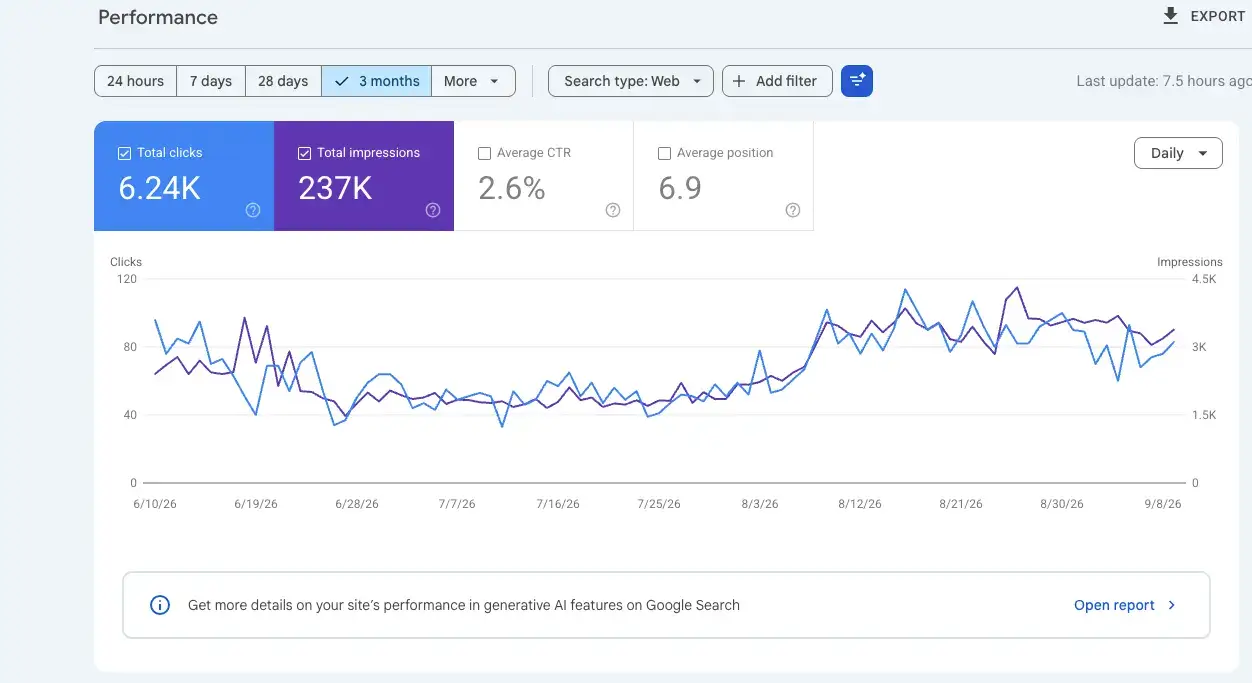
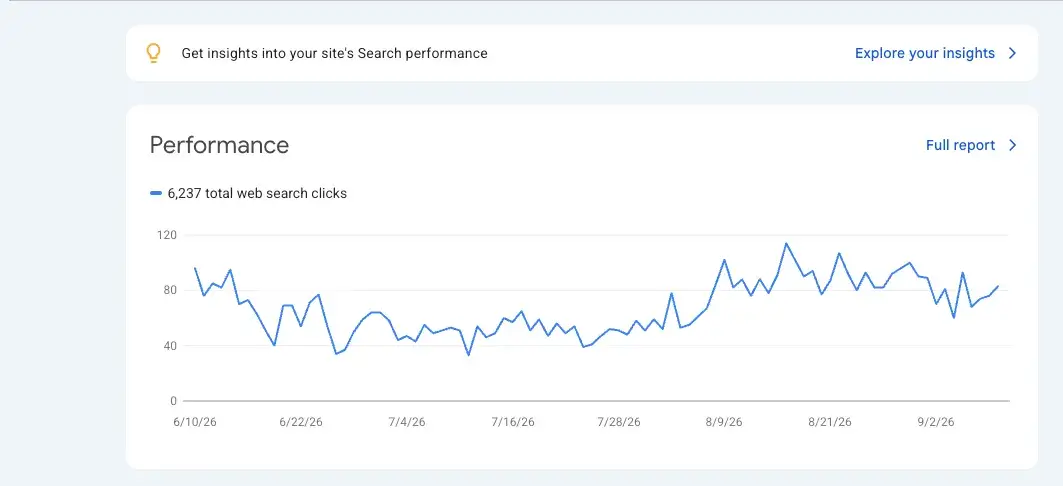
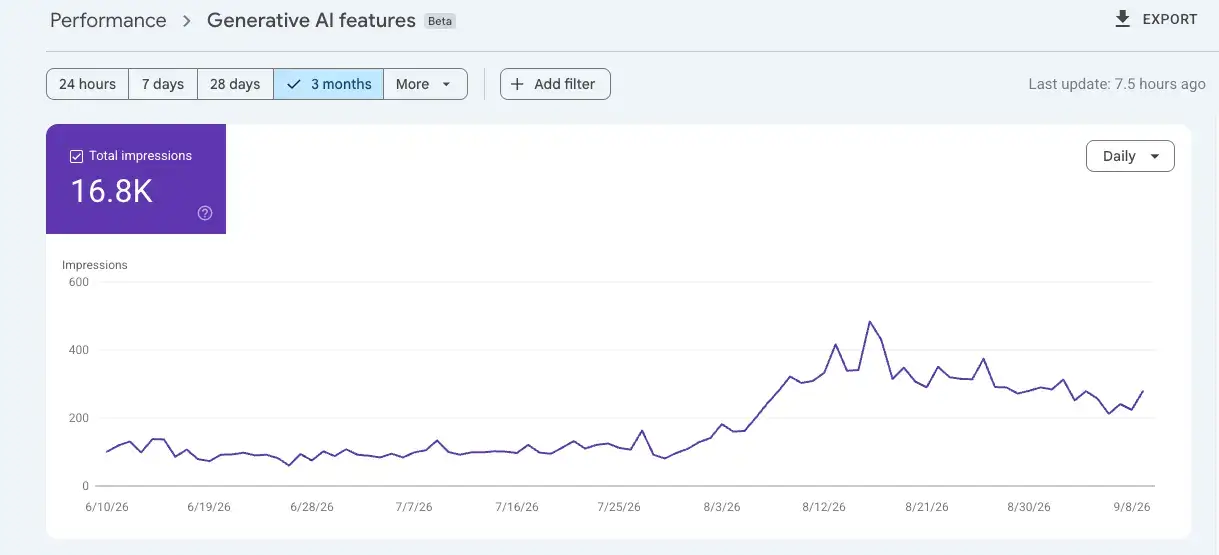
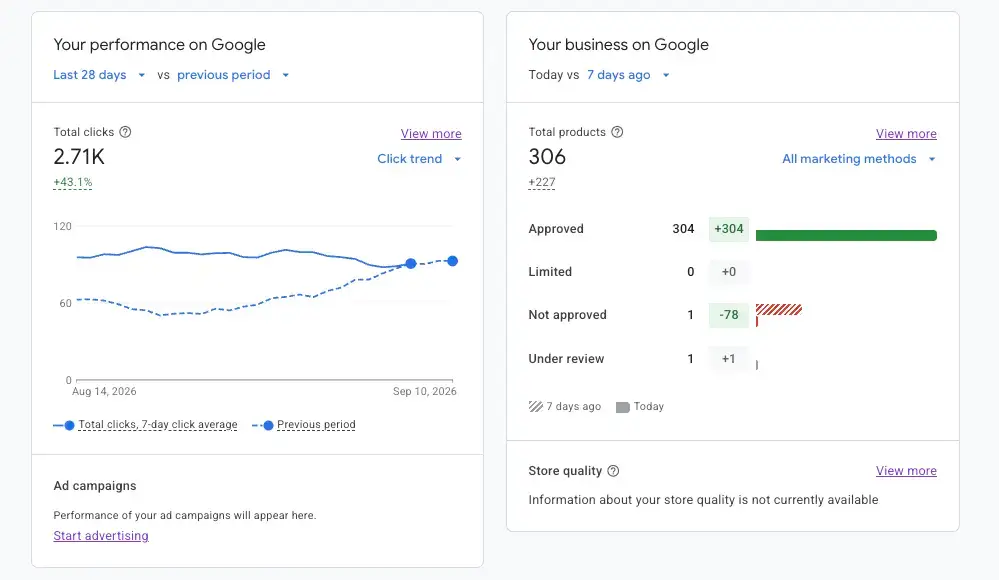
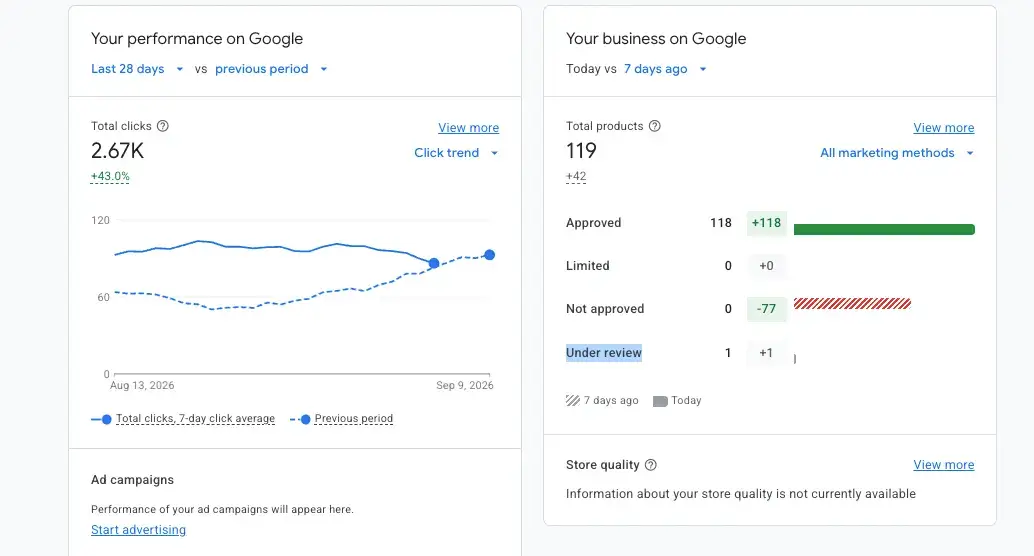
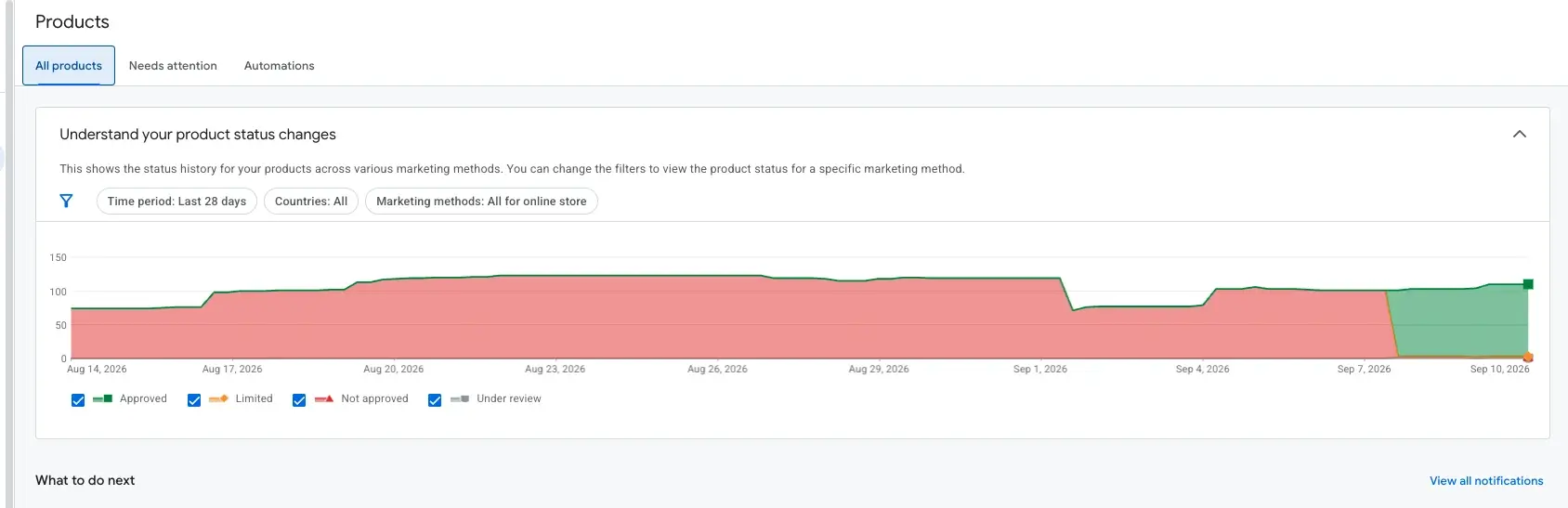
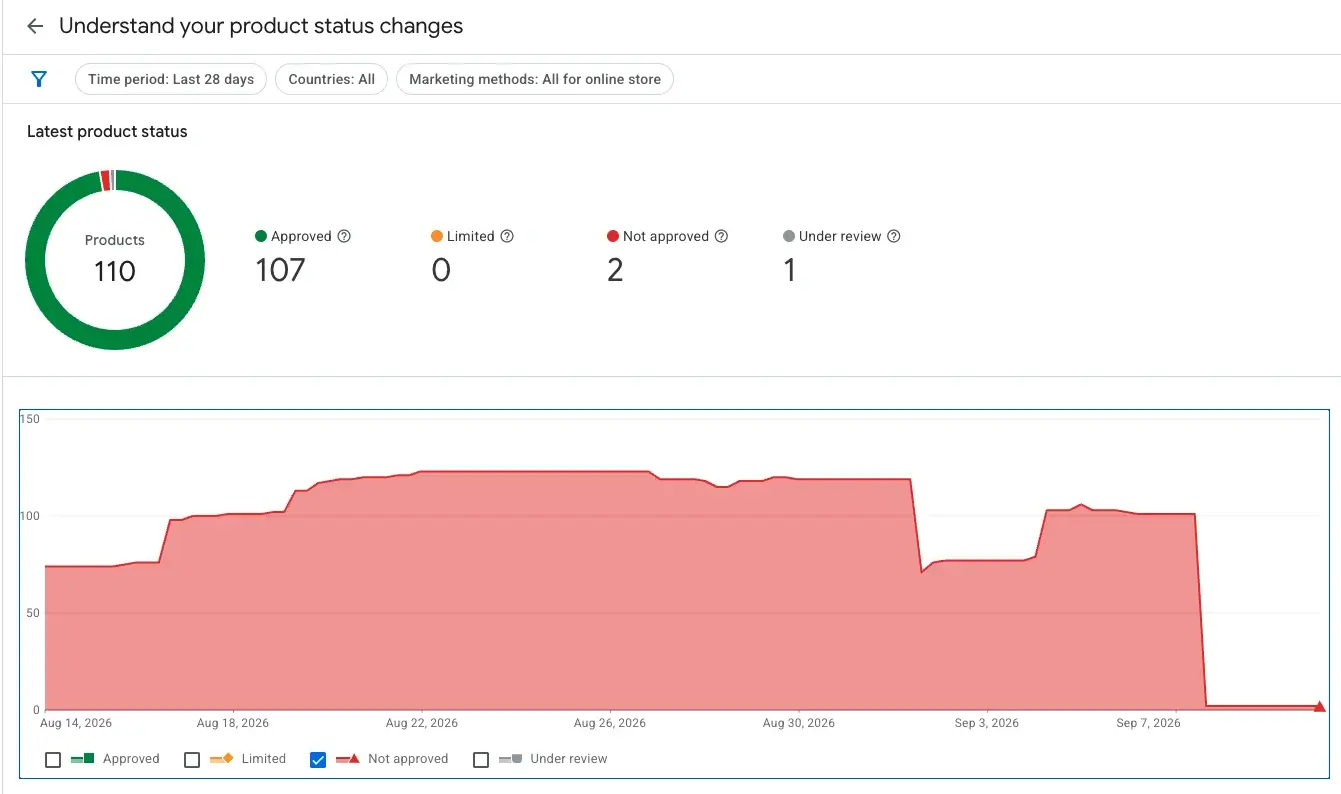
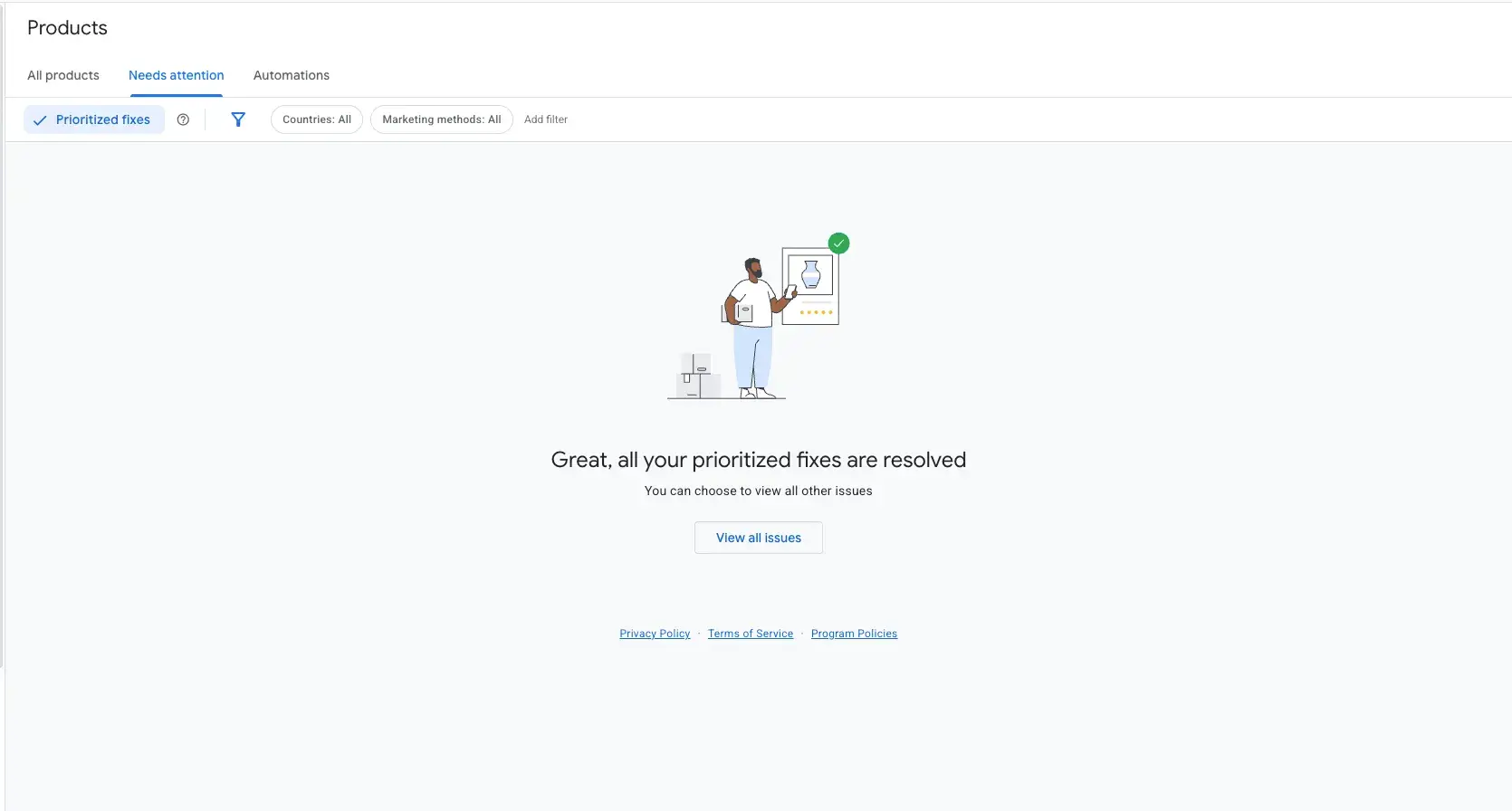
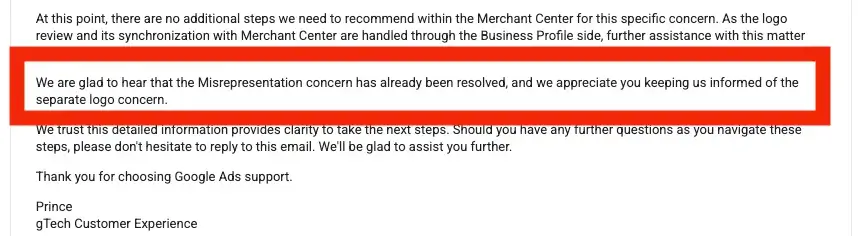
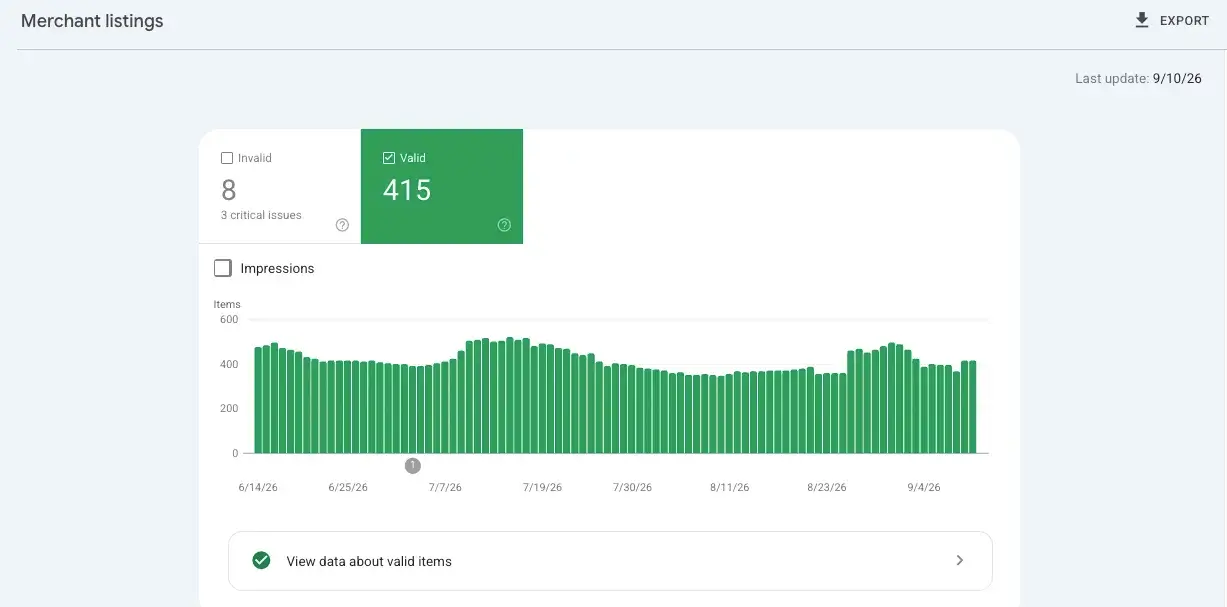
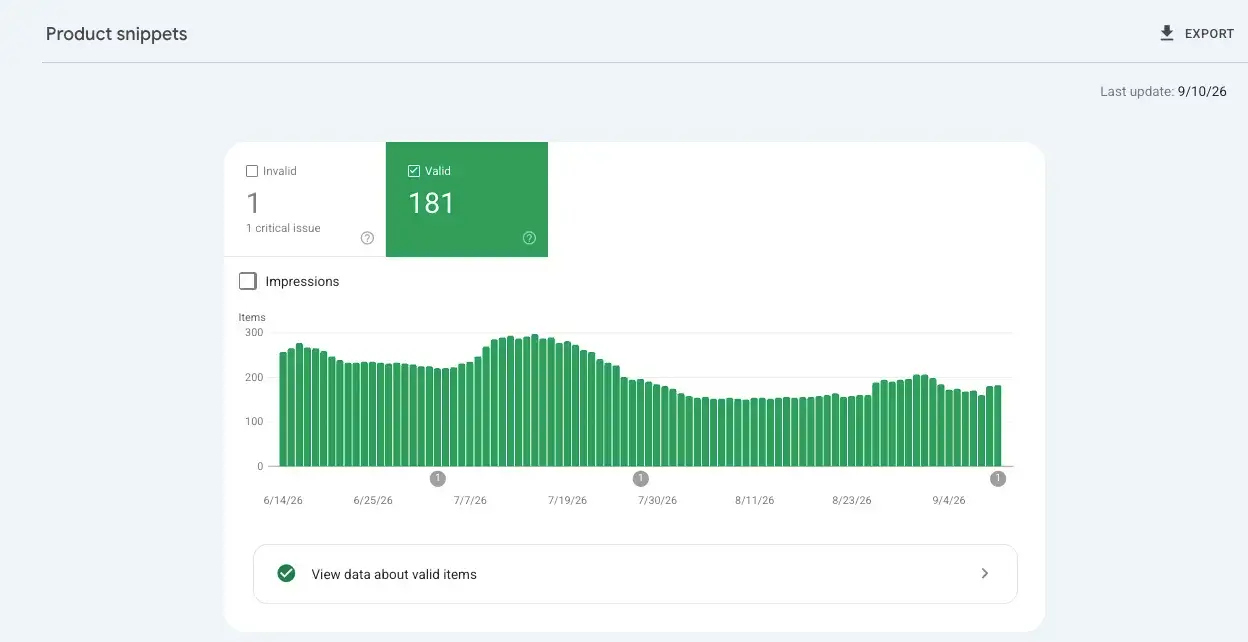
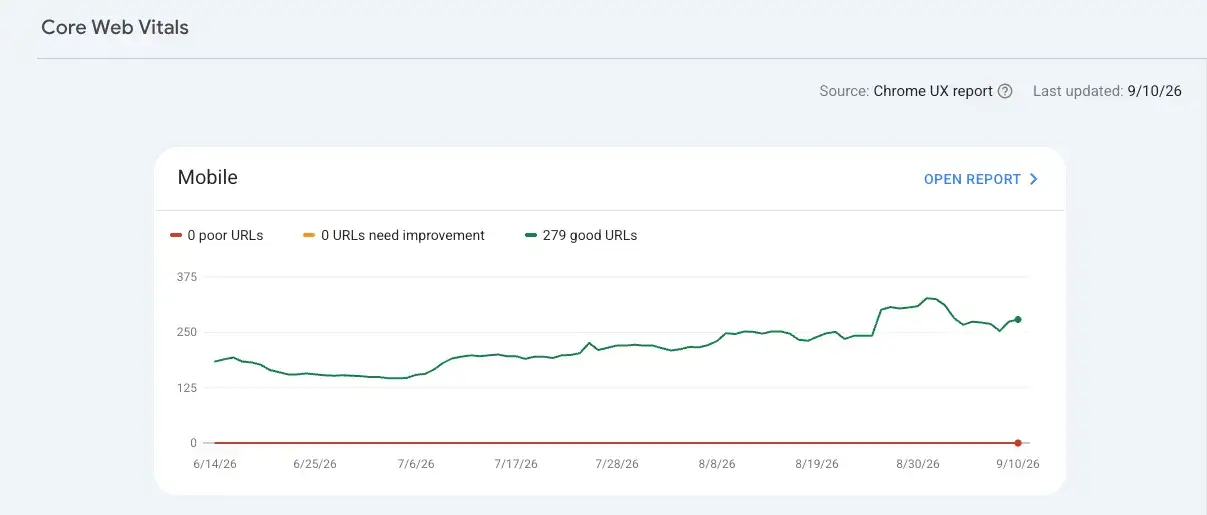
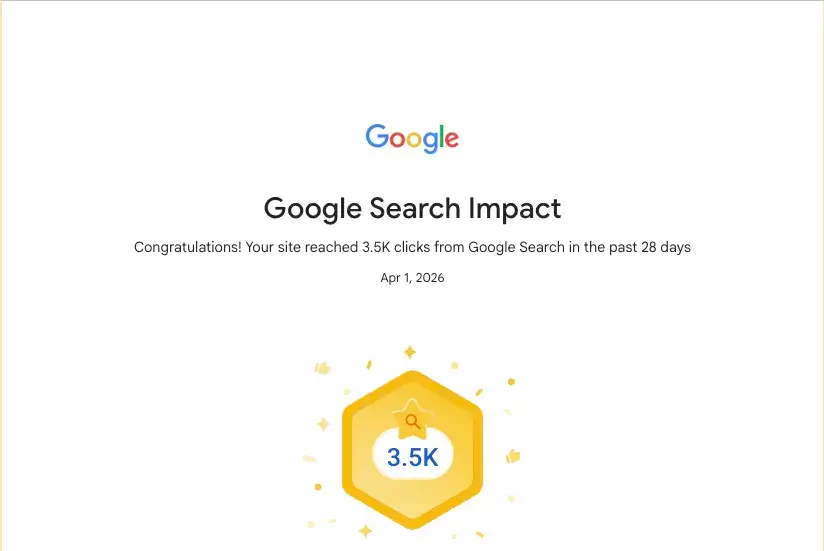
Search performance — 3 months · 6.24K clicks · 237K impressions · 2.6% CTR · avg. position 6.9Search clicks — 6,237 total web search clicks · daily, Jun – Sep 2026Generative AI features — 16.8K impressions in Google's AI surfaces · 3 monthsMerchant Center overview — 28 days to 10 Sep 2026 · 2.71K clicks, +43.1% · 304 of 306 products approvedMerchant Center, 9 Sep — the day before · 118 of 119 approved · 0 not approved, 77 fewer than a week earlierProduct status history — not approved for weeks · approved from 7 Sep 2026Not approved, last 28 days — 75 – 125 products disapproved through August · zero from 7 SepNeeds attention — all prioritised fixes resolvedGoogle support — “the Misrepresentation concern has already been resolved” · gTech Customer ExperienceSupport thread — Merchant Center Support confirmed the Misrepresentation issue is resolvedMerchant listing markup — 415 valid · 8 invalid · 10 Sep 2026Product snippet markup — 181 valid · 1 invalid · 10 Sep 2026Core Web Vitals — mobile · 279 good URLs · 0 need improvement · 0 poor · 10 Sep 2026Search impact — 3.5K clicks in 28 days · Google's notice of 1 Apr 2026
The brief
A full catalogue Google would not list
Albanien.Shop is a family-run Shopify store in Monheim am Rhein, between Düsseldorf and Cologne. It sells what an Albanian household abroad wants and cannot find in a German shop — a plis or a qeleshe, the national team's jersey, a flag for the car and one for the balcony, a qifteli, a bust of Skanderbeg — to Albanians and Kosovars across Germany, Austria and Switzerland. The catalogue and the customers were there. What was not there was Google Shopping: a Misrepresentation flag on the Merchant Center account had the whole range sitting in "not approved" for weeks, which is a shop that ranks and still cannot show a single product where shoppers compare prices.
What I did
01
Clear the Merchant Center flag first
The account carried a Misrepresentation issue, and with it the whole catalogue sat in "not approved" — between 75 and 125 products at any point through August. Fixing the store's policy signals and working the case with Google support cleared it: support confirmed the concern resolved, and on 7 September the catalogue flipped to approved. 304 of 306 products by 10 September.
02
Product data Google can actually read
Merchant listing and product snippet markup made valid across the catalogue — 415 valid merchant listings and 181 valid product snippets in Search Console's structured-data reports — so a listing carries price, stock and shipping into the results and into Shopping without a feed rebuilt by hand.
03
Collections as landing pages, in the customer's languages
Category pages that say what the range is and who it is for, in German with Albanian, English and French behind proper hreflang, and the questions buyers ask answered on the page. Over the three-month window that is 237K impressions and 6.24K clicks at an average position of 6.9.
04
Fast enough for a phone
A diaspora shop gets browsed on a phone, on a bus, on a Sunday. Every one of the 279 mobile URLs in the Core Web Vitals report rates good — none poor, none needing improvement — and the good count climbed from around 190 in June.
05
Take the repeat work out of every order
The things that happen after every single order — confirmation, tracking, the review request, the restock notice — run without anyone remembering to, and the pre-sale questions that arrive in the same words ten times a week are answered from the product data. The owner's evenings go back to sourcing and packing.
Products not approved · 14 Aug – 10 Sep 2026
0 not approved since 7 Sep
75 – 125 products disapproved through August
304 of 306 approved by 10 Sep
+43.1% Merchant Center clicks, 28 days
2.71K clicks from Merchant Center listings
In your market
Four things break on almost every specialist store
Albanien.Shop had the second one in its Merchant Center form — a catalogue that ranked and still could not be listed. The other three are just as common, and none of them show up in a rankings report. They show up in a crawl, a feed diagnostic, and the owner's evenings.
Your customer searches in two languages and three countries
Someone in Stuttgart types "albanien trikot" in German, "plis" in Albanian and "albanian flag" in English, and shops from Germany, Austria or Switzerland with three currencies and two sets of customs rules. Most stores pick one language and one country, and go invisible for the rest of their own market.
The head terms belong to Amazon
A bare search like "albanien flagge" is contested by Amazon, the sportswear chains and flag wholesalers with a decade of authority behind them. A specialist store that funds that fight loses it. The searches it can own are the ones only a specialist can answer — the instrument, the cap, the tracht, the gift for a specific occasion.
Shopify makes duplicate URLs faster than you can write descriptions
Every product lives at its own URL and again under each collection, tag filters mint a page per combination, and four languages multiply all of it. Add supplier descriptions pasted into every shop that stocks the same item, and Google spends its crawl on permutations of the catalogue instead of the catalogue.
Every order still needs a person
The size question on WhatsApp, the where-is-my-parcel email, the review request, the restock notice when the supplier in Prishtina finally delivers — in a family-run shop each of these is done by hand, in the evening, after the packing. It works until the month it doesn't.
Common questions
What store owners ask first
Should a diaspora store be in German or in Albanian?
Both, but not equally. The default language should be the one of the country where the customer pays and takes delivery, because that is the language of the search with commercial intent — "trikot kaufen", not "blej fanellë". Albanian belongs as a translated layer, kept for the terms that only exist in Albanian: plis, qeleshe, jelek, qifteli. What sinks most stores is doing it halfway — a machine-translated storefront with German slugs, no hreflang and product names that mean nothing in either language.
Can a small Shopify store rank against Amazon for flags or jerseys?
Not on the bare term, and that fight is not worth funding. A specialist wins the specifics — the flag in a particular size, the concept kit, the Dardania flag, the jersey with a name on it — and the questions around them, which Amazon does not answer. Where the head term matters commercially, Google Shopping and Merchant Center listings put the store above the organic results for a fraction of what outranking Amazon would cost.
Is Shopify worse for SEO than WooCommerce?
It is more opinionated. The URL structure is fixed, products duplicate under every collection, and robots.txt and canonicals need a theme edit rather than a plugin. All of that is manageable in an afternoon, and none of it is the reason a store fails to rank. The reasons are the same on every platform: collection pages with no words on them, supplier copy everywhere and a blog that writes about the brand instead of about the customer's occasion.
What should a small shop automate first?
The things that happen after every single order and need no judgement: the confirmation, the tracking update, the review request a week after delivery, the restock notice. Then the pre-sale questions that arrive in the same words ten times a week. What should stay human is anything involving a complaint or a custom order — automating those is how a 4.9-star shop stops being one.
How is this different from just running ads?
Ads rent the head terms at a price that rises every year. Organic builds the long tail once and keeps it. In practice the two split the work: paid for a launch — the new national kit, the weeks before a match — where speed matters more than cost, and organic for the evergreen demand that a wedding season or a baptism produces every year regardless. The mistake is using ads to paper over a store that cannot rank on its own.
Keep reading
More client results
Use case · Construction & trades
SEO & Automation for Construction & Trades
Win the map pack in the towns you drive to, turn the Business Profile into the phone line, and stop losing quotes to whoever answered first.
I use optional analytics and advertising cookies to understand site usage, improve the experience, and measure or personalise marketing. You can accept or reject them, and change your mind later. See the Privacy Policy.